
Clear records
history record

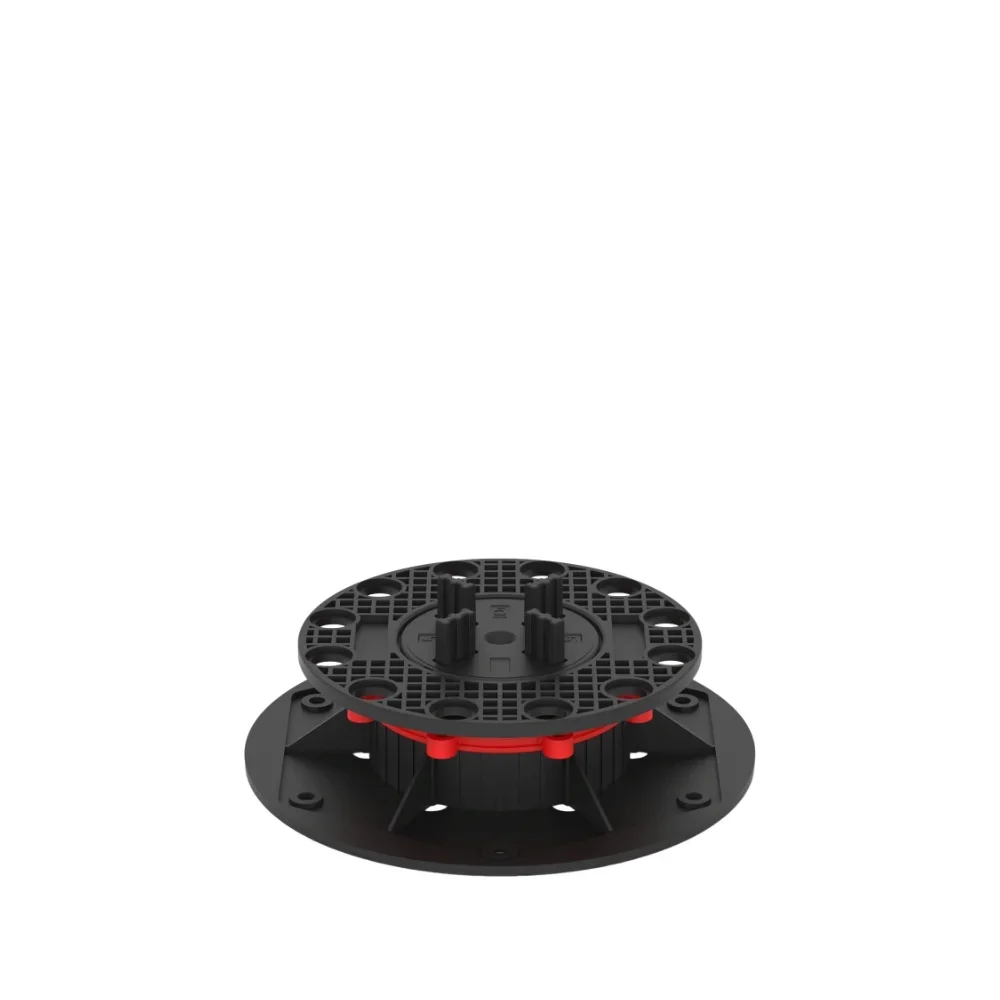
Adjustable Pedestal Supports for Indoor Flooring Engineering Guide: Load Transfer and Leveling Precision
In modern construction environments such as data centers, commercial exhibition spaces, rooftop installations, and modular interior renovations, pedestal supports for indoor flooring have evolved from simple height-adjustment accessories into critical structural load-transfer components that define the long-term stability of entire raised flooring systems.
Unlike traditional flooring methods that rely on continuous slab contact, raised floor systems depend entirely on discrete support points. This means every pedestal acts as a localized structural column, and the overall system performance is determined not by the surface material itself, but by the cumulative mechanical behavior of thousands of load-bearing points working in synchronized distribution.
For both Diy pedestal supports for indoor flooring and Adjustable pedestal supports for indoor flooring, the engineering challenge is not installation simplicity—it is achieving controlled load transfer, precise elevation alignment, and long-term resistance to creep deformation under sustained static and dynamic loads.
In real engineering environments, even minor deviations in pedestal spacing, base friction characteristics, or thread adjustment accuracy can lead to cumulative system-level failures such as panel deflection, vibration amplification, or localized structural instability.
Why Pedestal-Based Flooring Systems Dominate Modern Interior Infrastructure
Raised flooring systems are widely used in environments where underfloor access, thermal management, or cable routing flexibility is required. This includes data centers, telecom facilities, commercial office buildings, and modular exhibition structures.
The fundamental advantage of pedestal-based systems lies in their ability to decouple structural load from surface finishing layers. Instead of relying on a monolithic slab, the system distributes vertical load through a grid of adjustable support points.
From a structural engineering perspective, this creates three critical advantages:
Load separation between structural substrate and functional flooring layer, allowing independent optimization of surface material and load-bearing system design
Flexible integration of mechanical and electrical systems beneath the floor without compromising surface integrity or requiring structural reconstruction
High adaptability to uneven base conditions, enabling compensation for substrate irregularities without extensive civil modification work
However, this modularity introduces a new engineering dependency: the entire system stability becomes governed by the mechanical consistency of each pedestal unit and its load transfer behavior under long-term compression.
Load Transfer Mechanics: Why Each Pedestal Functions as a Structural Column
A pedestal support system does not behave like a passive spacer. Each unit functions as a micro-load-bearing column, transmitting vertical forces from floor panels into the base substrate.
The load path follows a strict mechanical sequence:
floor panel → pedestal head plate → threaded adjustment column → base plate → substrate interface
Each interface introduces potential deformation zones. The overall system stability depends on minimizing micro-movements across these interfaces under both static and cyclic loading.
In high-density applications such as data centers, point loads from server racks can exceed several hundred kilograms per pedestal cluster. This makes load distribution consistency not optional, but structurally mandatory.
Diy Pedestal Supports for Indoor Flooring: Installation Logic and Field Engineering Constraints
In practical construction scenarios, Diy pedestal supports for indoor flooring are often used in modular renovation projects, small-to-medium commercial installations, and flexible interior retrofitting environments where full-scale structural engineering systems are not deployed.
However, “DIY installation” does not imply reduced engineering complexity. Instead, it shifts complexity from factory prefabrication to on-site adjustment accuracy.
Base Surface Condition and Substrate Preparation Logic
The performance of any pedestal system begins with the condition of the base substrate. Even high-quality adjustable systems cannot compensate for extreme irregularities without introducing long-term stress concentration.
Key engineering considerations include:
Surface flatness deviation directly affects pedestal load distribution consistency, as uneven base contact causes localized stress concentration that accelerates creep deformation over time rather than distributing load uniformly across the support grid
Substrate compressibility variation, especially in secondary concrete layers or lightweight leveling screeds, introduces differential settlement behavior that gradually alters floor level accuracy after installation
Surface contamination such as dust, oil, or moisture reduces base friction coefficient, increasing lateral slip risk under dynamic loading conditions such as rolling carts or maintenance equipment movement
Installation Spacing and Structural Load Distribution Behavior
Pedestal spacing is not a geometric convenience parameter—it is a structural load distribution variable that directly determines system stiffness.
If spacing is too wide:
Floor panels experience increased bending moment between support points, leading to perceptible deflection under concentrated loads
Localized stress increases at pedestal heads, accelerating fatigue and increasing long-term deformation risk
Vibration propagation becomes more pronounced, especially in high-traffic or equipment-heavy environments
If spacing is too tight:
Material cost increases without proportional structural benefit
Installation complexity increases, reducing labor efficiency and increasing alignment error probability
Thermal and service access space below the floor becomes unnecessarily constrained
Therefore, spacing must be engineered based on expected load profiles, panel stiffness, and usage environment rather than standardized layout assumptions.
Manual Adjustment Mechanisms and Error Accumulation Control
In DIY systems, leveling accuracy is determined by the precision of manual thread adjustment mechanisms.
The primary engineering challenge is not achieving initial level alignment, but maintaining consistency across a distributed grid of supports.
Key control factors include:
Thread pitch resolution, which defines the smallest achievable vertical adjustment increment and directly impacts final surface flatness tolerance in large-area installations
Operator-induced torque variation, which can introduce micro-level height inconsistencies between adjacent pedestals if tightening force is not standardized
Cumulative error propagation across multiple adjustment points, where small deviations accumulate into measurable surface unevenness over large installation areas
Without controlled adjustment methodology, even high-precision pedestal components can produce uneven flooring outcomes due to human variability during installation.
Adjustable Pedestal Supports for Indoor Flooring: Engineering Stability Under Long-Term Load
In large-scale commercial and industrial environments, Adjustable pedestal supports for indoor flooring are required to maintain performance under continuous static load conditions combined with environmental variation such as humidity, temperature cycling, and equipment vibration.
Long-Term Creep Behavior and Material Deformation Control
One of the most critical engineering parameters in pedestal design is creep resistance—the tendency of materials to slowly deform under sustained load.
In raised flooring systems, creep manifests as gradual height reduction at support points, resulting in:
Progressive loss of floor leveling accuracy over time
Uneven load redistribution across adjacent pedestals
Increased stress concentration in previously stable support zones
High-performance pedestal systems mitigate this through:
High-modulus composite material selection to reduce long-term deformation under sustained compressive loads
Reinforced internal load paths that distribute stress away from localized thread engagement zones
Structural geometry optimization that minimizes stress concentration at load-bearing interfaces
Environmental Stability: Temperature and Humidity Effects on Structural Behavior
Indoor environments such as data centers and commercial spaces often experience controlled but non-constant temperature and humidity conditions.
These environmental variations affect pedestal systems in several ways:
Thermal expansion and contraction cycles can introduce micro-adjustments in pedestal height if material coefficients are not properly matched across components
Humidity fluctuations can affect composite material stiffness, subtly altering load distribution characteristics over long operational periods
Repeated thermal cycling can accelerate fatigue in threaded adjustment interfaces if not properly engineered for cyclic expansion tolerance
Therefore, adjustable pedestal systems must be designed as environmentally adaptive structural components rather than static mechanical supports.
Anti-Slip Stability and Lateral Force Resistance in Real Installation Conditions
While pedestal systems are primarily designed for vertical load transfer, real-world environments introduce lateral forces caused by:
Human traffic movement
Equipment rolling loads
Vibration from mechanical systems
Seismic or structural micro-movements in building frameworks
Without proper anti-slip design, these lateral forces can cause gradual displacement of pedestal positions, leading to misalignment of the entire flooring grid.
Effective engineering solutions include:
High-friction base interface materials that increase static friction coefficient between pedestal base and substrate, preventing gradual lateral drift under repeated dynamic loading conditions
Mechanical interlocking geometries between pedestal base and floor structure that resist directional shear forces rather than relying solely on surface friction
Structural reinforcement in base geometry to distribute lateral loads across a wider contact area, reducing localized stress accumulation and improving long-term positional stability
Homedin Industrial Engineering Capability in Pedestal Support Systems
Homedin Industrial Co., Ltd. specializes in adjustable pedestal systems for architectural and landscape applications, including stone supports, floor support systems, keel supports, and elevated structural platforms.
In pedestal supports for indoor flooring, Homedin applies a system-level engineering approach that integrates:
High-strength composite material structures designed for long-term compressive load stability under continuous static and dynamic conditions
Precision threaded adjustment mechanisms that enable controlled height calibration across large installation surfaces
Modular structural architecture that improves installation efficiency while maintaining load distribution consistency across varied substrate conditions
Engineering support systems for complex construction scenarios including data centers, commercial interiors, rooftop structures, and prefabricated building environments
This integrated approach ensures that pedestal systems function not as isolated components, but as part of a complete load transfer and leveling ecosystem.
Conclusion
A modern pedestal supports for indoor flooring system is fundamentally a structural load distribution network rather than a simple installation accessory. Its performance is defined by load transfer consistency, long-term deformation resistance, and precision of height adjustment under real-world construction variability.
For Diy pedestal supports for indoor flooring, the key engineering challenge lies in controlling installation accuracy, spacing logic, and manual adjustment consistency under on-site conditions. For Adjustable pedestal supports for indoor flooring, the critical focus shifts toward long-term structural stability, creep resistance, and environmental adaptability under continuous load cycles.
Ultimately, system reliability is determined by the integration of material science, mechanical design, and installation engineering logic across the entire support grid.
Through high-strength composite structures, precision adjustment mechanisms, and modular load distribution design, Homedin Industrial provides pedestal support solutions engineered for high-precision leveling, long-term stability, and reliable performance in complex indoor flooring systems.

With advanced manufacturing and rigorous quality control, Homedin delivers consistent product quality and responsive after-sales support. We welcome partners worldwide to visit our factory and discuss collaboration.
Frequently Asked Questions
What is an adjustable pedestal used for?
An adjustable pedestal (also called a deck support or paver pedestal) raises tiles, decking boards, timber or stone above the substrate to create a level, ventilated and drained raised floor. Common uses are rooftops, terraces, balconies, plazas and pool decks.
How much weight can an adjustable pedestal support?
HOMEDIN pedestals are SGS load-tested: the HE Series up to 2,000 kg per support, the B Series 2.5–3.5 t, and the S Series rubber shim ≥3,152 kg. Always size by worst-case point load and support spacing.
What height range do adjustable pedestals cover?
Typical pedestals adjust from about 20 mm up to 260–392 mm; extension rings push heights further (B Series to 480 mm, HE Series to 392 mm). Pick the model by your required finished-floor height.
Can adjustable pedestals handle sloped or uneven surfaces?
Yes. Self-leveling heads (HOMEDIN XA rubber / XB plastic) compensate slopes up to 5%, and shim pads level minor irregularities — ideal for retrofit balconies and uneven substrates.
Are HOMEDIN pedestals certified and suitable for outdoor use?
Yes. Bodies are UV-stabilised PP or PP+glass-fibre (TPE/EPDM rubber for the S Series), rated from −30 °C to +120 °C, and verified by SGS, CE, RoHS and REACH.